
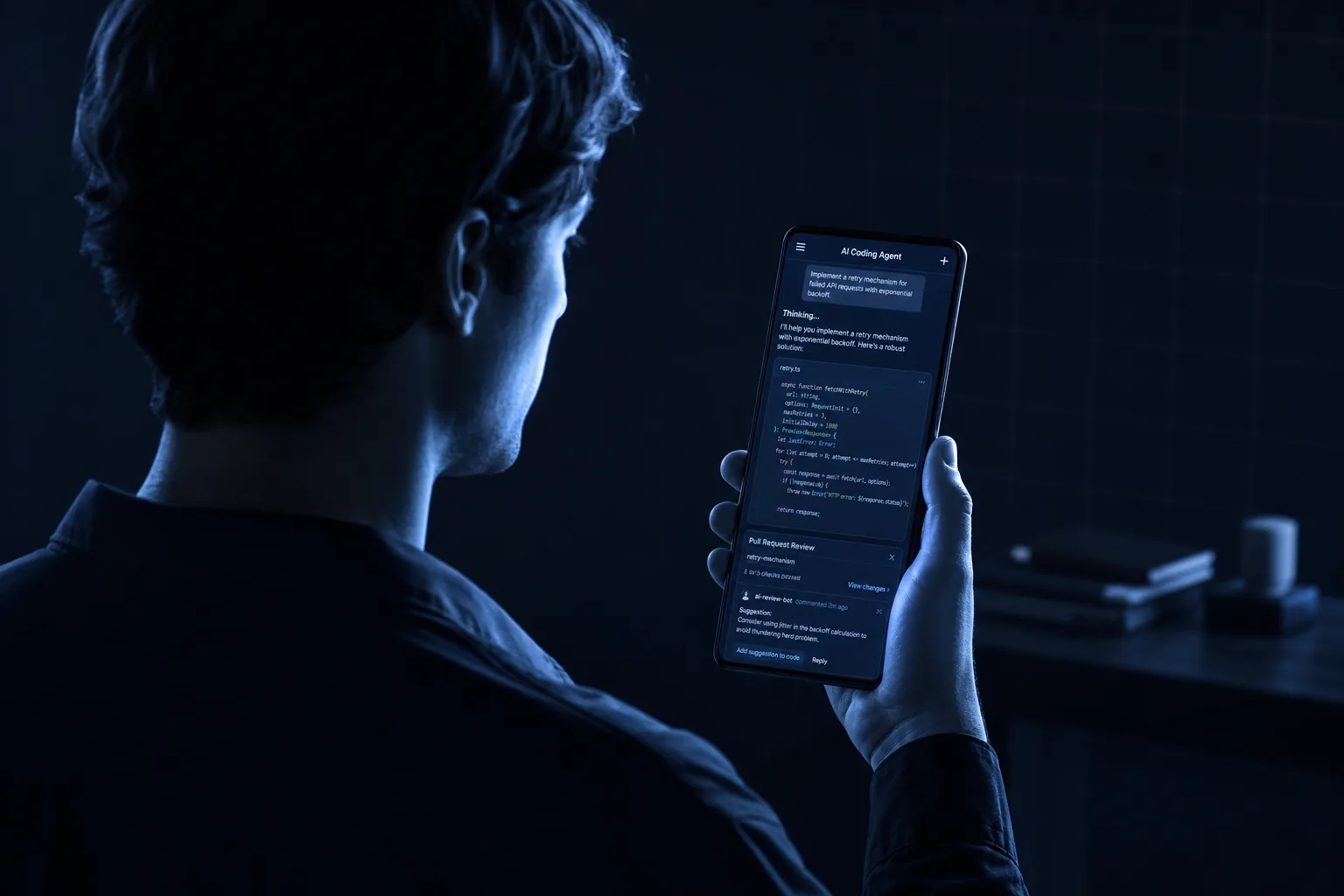
You leave your desk, head to the gym, and the code keeps shipping.
That is not a productivity fantasy. As of 2026, it is a straightforward technical reality for any founder or operator willing to set it up. Two products launched this year — Anthropic's Claude Code Remote Control (February) and OpenAI's Codex mobile (May) — have made the asynchronous coding agent a practical daily tool, not a demo you watch at a conference.
This piece explains what these tools actually do, who is already using them this way, and what it means for founders who are tired of being chained to their machines.
What "delegate the build" actually means in 2026
The phrase gets used loosely, so let's be precise.
A coding agent like Claude Code or Codex accepts a task — "add pagination to the dashboard", "write tests for this module", "refactor this service to match the new schema" — and then executes autonomously: reads your codebase, writes code, runs commands, opens pull requests. It does not need you to hold its hand through each step.
What changed in 2026 is the monitoring layer. You no longer have to sit at your laptop to know what the agent is doing, approve its next move, or course-correct when it hits an edge case. You can do all of that from your phone, from anywhere.
That is the shift. Not "AI writes code" — that has been true for a few years. The shift is: you are no longer required to be present for the work to continue.
Claude Code Remote Control: your laptop keeps running, you don't have to
Anthropic launched Claude Code Remote Control as a research preview on 25 February 2026. The mechanics are straightforward: you start an agent session on your machine using the claude remote-control command (or the /rc shortcut), and Claude continues running entirely locally — nothing moves to the cloud. Your phone then becomes a window into that local session.
Push notifications tell you when a task completes or when the agent needs a decision. You review what it has done, approve or redirect, and put your phone back in your pocket. The agent carries on.
This matters for two reasons. First, the security model is clean — your code and credentials stay on your machine, not in a third-party cloud. Second, the interruption cost is minimal. You are not managing the agent; you are available to it when it has a genuine question, the same way a senior engineer is available to a junior without watching over their shoulder all day.
Claude Code Remote Control is available on Pro, Max, Team and Enterprise plans. Full setup detail is in Anthropic's official documentation.
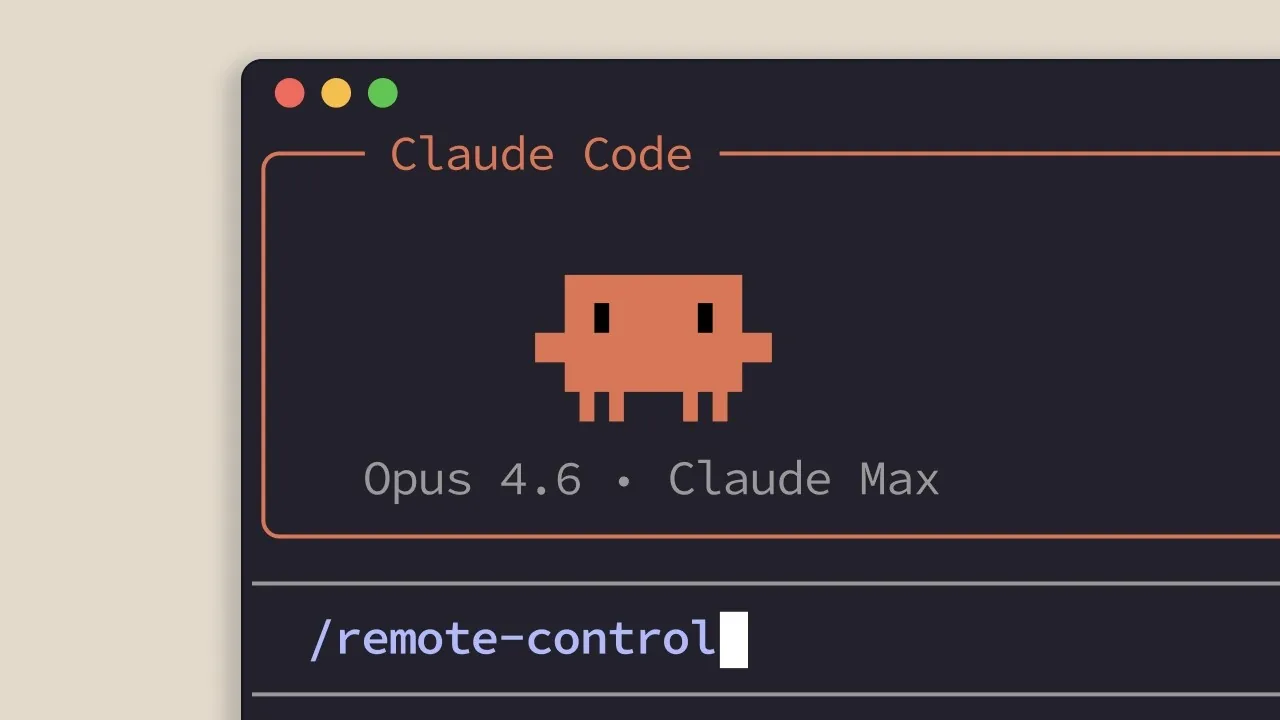
/remote-control command in the Claude Code terminal — the moment a desk-bound session becomes one you can drive from your phone. Source: Anthropic (Claude) — "Using Claude Code Remote Control". Click to play the official demo.Codex mobile: start work at your desk, finish it from anywhere
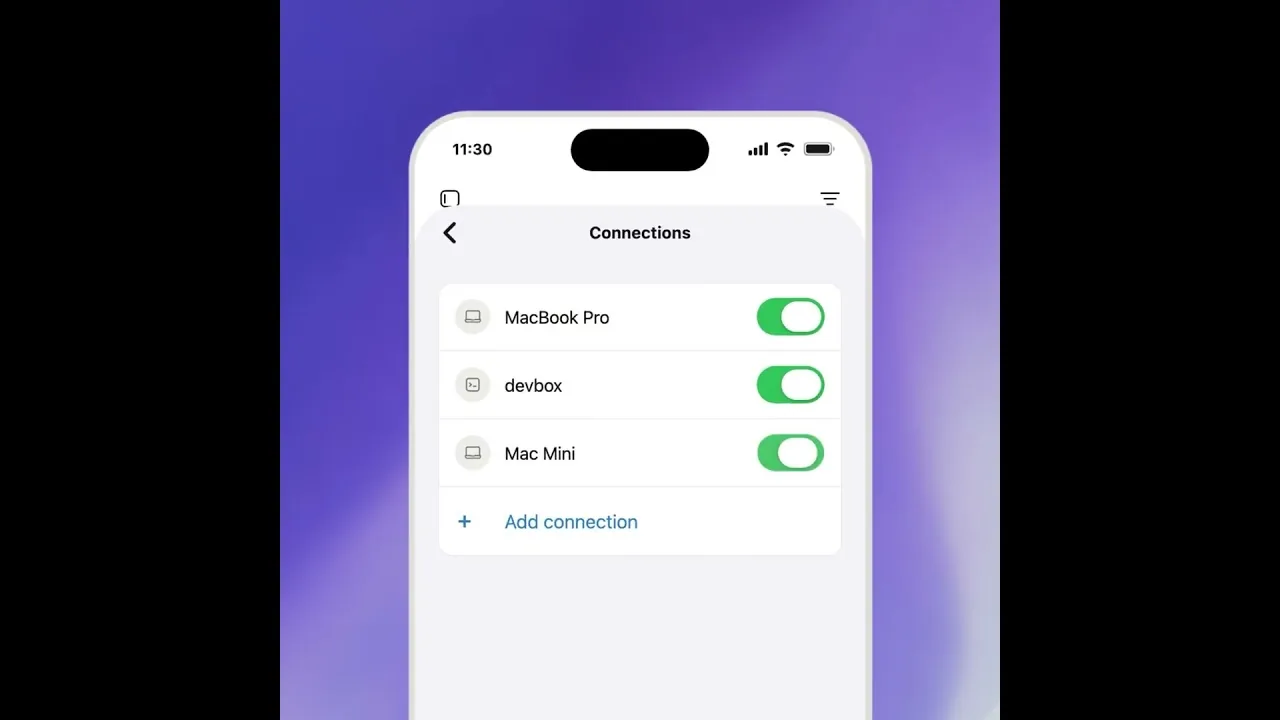
OpenAI announced Codex mobile on 14 May 2026, bringing async agent management into the ChatGPT iOS and Android apps. The architecture is similar in spirit: Codex runs on your Mac, Windows machine, or SSH host, and a secure relay layer connects your phone to that session. At launch, Codex had more than four million weekly users — a signal that async agent workflows are already mainstream, not niche.
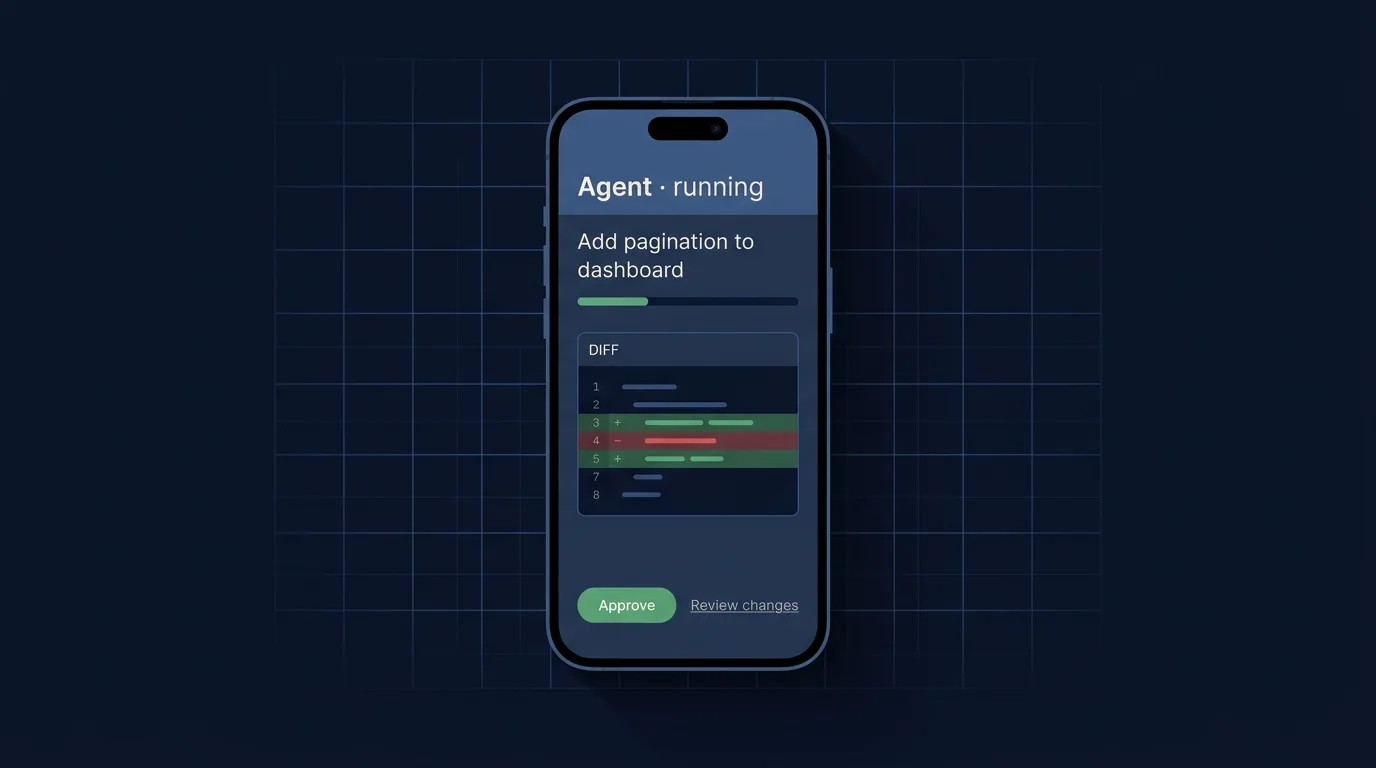
The practical workflow: you scope and kick off a task at your desk, then leave. From the app you can approve commands, review diffs, change direction, or simply watch the progress. If the agent finishes and you want to queue the next task before you get home, you do it from your phone.
OpenAI's launch announcement is worth reading for the relay architecture detail. The original Codex app announcement from February 2026 covers the multi-agent parallel management that makes running several workstreams simultaneously practical.
Who is already working this way?
This is not theoretical. The operators are real and the numbers are specific.
Boris Cherny, who created Claude Code at Anthropic, has described his personal workflow as having "shifted from manual prompting to building autonomous loops." According to reporting from Samtash, he runs more than 100 parallel agents from his iPhone, generating roughly 150 pull requests per day. That is one person, one phone, the output of a mid-sized engineering team.
Camille Epitalon, CTO at Verso, is profiled in Hexa Media waking up to find eight new pull requests opened overnight. The agents worked through the night; the CTO reviewed the results over morning coffee. This is not a special configuration — it is what async agents look like in a real engineering workflow.
These examples are not outliers chasing a trend. They are early adopters revealing what the default will look like in two to three years.
Why this is a work-life balance argument, not just a productivity one
The standard productivity framing is: AI agents multiply your output. That is true, and it is also incomplete.
The more important claim is this: synchronous work culture is the bottleneck, not headcount and not skill. When your presence is required for work to continue, you are the constraint. You cannot step away, rest, or think clearly because stopping means the work stops too.
Async AI agents break that dependency. The work continues because the agent continues. You step away not to fall behind, but because staying glued to your screen adds no value at that moment.
A 2026 trend analysis from The Fast Mode frames this as the year synchronous work culture begins to give way — enterprise and founder workflows shifting toward models where output is measured by results, not by the hours someone was online. That shift benefits founders and operators disproportionately, because their leverage is highest when they can think and create rather than execute and supervise.
The gym example is not a gimmick. A founder who exercises, sleeps properly, and has mental space to think strategically makes better decisions than one who is permanently on-call to their own codebase. Async agents make that possible without sacrificing output.
How to set this up: practical starting points
If you want this workflow running this week, here is where to start:
For Claude Code Remote Control
- Requires a Claude Pro, Max, Team or Enterprise plan.
- Start a session with
claude remote-controlor/rcfrom your project directory. - Install the Claude mobile app and connect to your session.
- Configure push notifications for task completion and decision prompts.
- Start with a bounded, well-defined task the first time — something you can verify easily. Build trust in the setup before delegating anything critical.
For Codex mobile
- Access via the ChatGPT iOS or Android app.
- Connect to your local machine or an SSH host.
- Scope tasks clearly before you leave your desk — the more precise the brief, the less course-correction you will do remotely.
- Use the diff review on your phone to stay across what changed before approving.
General principles for async agent work
- Write precise task descriptions. Ambiguity that you would clarify verbally in five seconds becomes a stall or a wrong turn when you are not there.
- Set clear stop conditions: "open a PR when done" or "stop and notify me if you hit X".
- Review outputs in batches rather than monitoring continuously — that is the point.
- Keep a short list of task types that are genuinely safe to delegate async (tests, refactors, documentation, migrations) versus those that warrant you being present (anything touching production secrets or irreversible state).
What this means if you run a team or a product
The conversation above is mostly framed around solo founders, but the principle extends.
If you lead an engineering team, async agents mean your people spend less time on routine execution and more time on architecture, review, and the kind of judgment that actually requires a human. If you are building a product, it means you can compress your build cycles without burning your team out.
At NavAIgate, this is precisely the kind of leverage we help SaaS teams and enterprise operators actually adopt — not demo, adopt. There is a meaningful gap between knowing these tools exist and having them running reliably in your workflow. If closing that gap is on your agenda, a discovery call is the fastest way to map what that looks like for your specific context.
The agents are working. You should be allowed to step away.
Sources / further reading
- Anthropic — Claude Code Remote Control official documentation
- OpenAI — "Work with Codex from anywhere" (14 May 2026)
- OpenAI — "Introducing the Codex app" (2 Feb 2026)
- Samtash — "Boris Cherny, Claude Code Creator, Runs Hundreds of AI Agents on His Phone"
- Hexa Media — "How this CTO's agents code for him through the night"
- The Fast Mode — "2026: The Year Work Goes Asynchronous, and AI Agents Take Over"
Make it real
Get async AI agents running in your workflow.
There is a gap between knowing these tools exist and having them running reliably. A discovery call is the fastest way to map what that looks like for your context.